De Naald

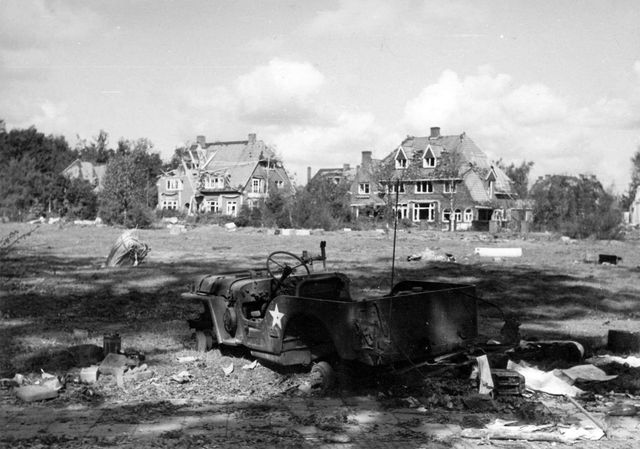
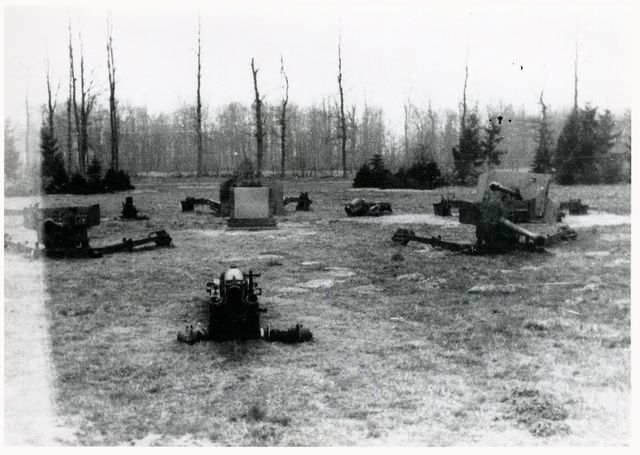
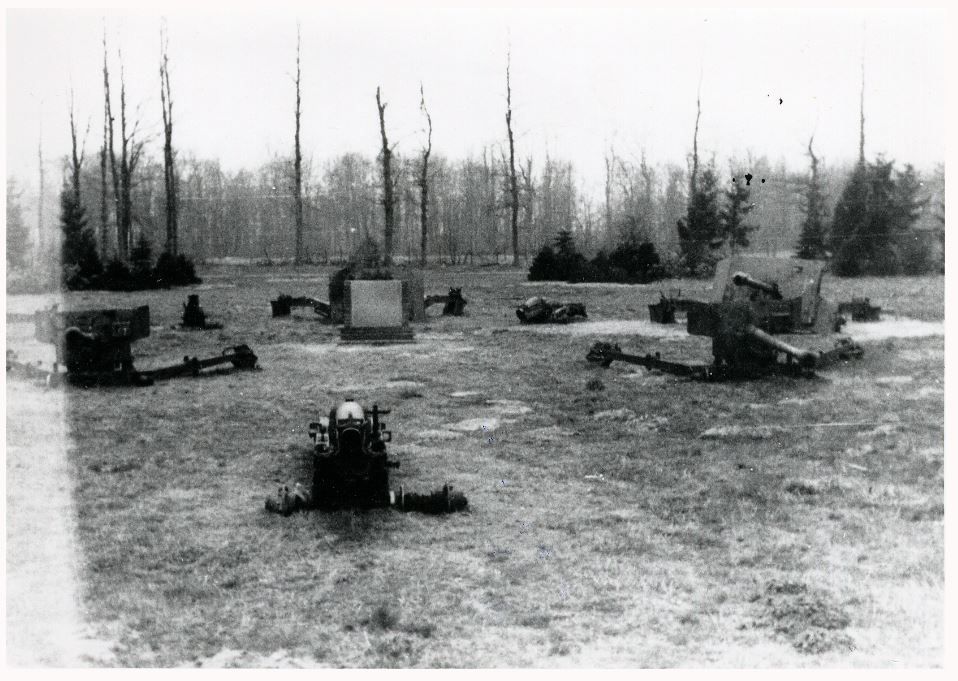
During the battle, the grassy field in front of Hartensteinlaan was mainly used by the British airborne troops to attract the attention of the supply aircraft. Unfortunately, supplies were not always dropped accurately here either. After the British troops had been evacuated and the battle was over, the field was littered with abandoned vehicles and supplies.
Within a year of the return of the residents of Oosterbeek, who had been forced to evacuate following the Battle of Arnhem, it was decided that a war memorial should be erected. This memorial was to be situated on the lawn in front of Hartensteinlaan. As early as 1945, money was collected from the local population for this purpose. At a time of great scarcity and in a village where signs of destruction were still visible everywhere, building materials were set aside for the monument rather than for reconstruction.
In 1946…
During the battle, the grassy field in front of Hartensteinlaan was mainly used by the British airborne troops to attract the attention of the supply aircraft. Unfortunately, supplies were not always dropped accurately here either. After the British troops had been evacuated and the battle was over, the field was littered with abandoned vehicles and supplies.
Within a year of the return of the residents of Oosterbeek, who had been forced to evacuate following the Battle of Arnhem, it was decided that a war memorial should be erected. This memorial was to be situated on the lawn in front of Hartensteinlaan. As early as 1945, money was collected from the local population for this purpose. At a time of great scarcity and in a village where signs of destruction were still visible everywhere, building materials were set aside for the monument rather than for reconstruction.
In 1946, Major-General Urquhart, commander of the 1st Airborne Division, laid the foundation stone, and a year later the monument was unveiled by Queen Wilhelmina. Even today, De Naald plays an important role during the annual commemoration of the Battle of Arnhem.
The monument features four scenes: the paratroopers’ landings, the women of Oosterbeek tending to the wounded, the support provided by the Resistance, and the heroic resistance of the Airborne troops.